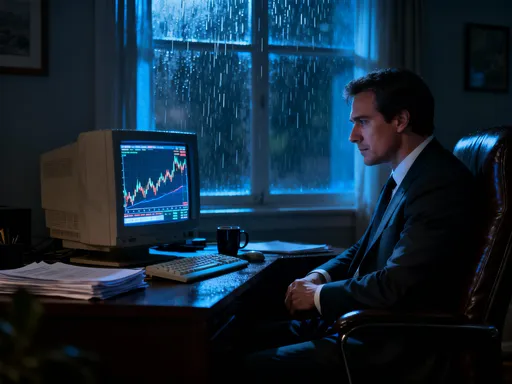
What I Learned About Risk in Wealth Management — The Hard Way
Managing wealth isn’t just about chasing returns—it’s about seeing risks before they hit. I once thought diversification meant spreading money across a few funds. Then a market dip wiped out gains I’d worked years to build. That wake-up call forced me to dig deeper. What are the real risks hiding in plain sight? How do you spot them early? This is what I’ve learned through trial, error, and real losses—lessons that changed how I manage money forever. It wasn’t a single mistake that caused the damage, but a series of assumptions I hadn’t questioned. I had trusted surface-level strategies without understanding the underlying mechanics. What followed was not just financial loss, but a shift in mindset. I began to see risk not as an occasional threat, but as a constant presence that must be monitored, measured, and managed with discipline. This journey taught me that true financial resilience isn’t built by chasing high returns, but by constructing a system that can endure uncertainty, adapt to change, and protect what matters most—your long-term financial security.
The Wake-Up Call: When My Portfolio Blew Up
It started with confidence—perhaps too much of it. At the time, I considered myself a prudent investor. My portfolio included a mix of large-cap stocks, bond funds, and a small allocation to real estate investment trusts. On paper, it looked balanced. I had followed the common advice: diversify across asset classes, hold for the long term, and avoid emotional decisions. But in 2022, when interest rates began to rise and inflation surged, my so-called balanced portfolio reacted in ways I hadn’t anticipated. The bond funds, which I had counted on for stability, dropped sharply. At the same time, the stock holdings in growth sectors—technology and consumer discretionary—plunged. My real estate investments, tied to rising borrowing costs, stalled. Within six months, nearly 30 percent of my portfolio’s value had evaporated. I wasn’t alone—many investors faced similar losses—but the personal impact was profound. I had worked for over a decade to build that capital, and in less than a year, a significant portion was gone.
The real shock wasn’t just the loss itself, but the realization that my understanding of risk had been superficial. I had assumed that because my investments were in different categories, I was protected. But I failed to see how many of them were exposed to the same macroeconomic forces—particularly rising interest rates. The bonds and growth stocks, though different in type, both suffered when rates climbed. This was a classic case of hidden correlation: assets that appeared diverse were actually moving in tandem when stress hit the system. My diversification was more illusion than reality. The experience forced me to confront a hard truth: managing money isn’t just about picking the right investments; it’s about understanding how they interact under pressure. I had treated risk as something external, like market noise, rather than an intrinsic feature of my own choices.
This event became a turning point. I stopped focusing solely on performance and began asking deeper questions: What assumptions am I making? What could go wrong that I’m not preparing for? How would my portfolio behave in a crisis I haven’t lived through? I realized that financial planning wasn’t just about growth—it was about survival. The goal shifted from maximizing returns to minimizing permanent loss. That change in perspective laid the foundation for a more thoughtful, structured approach to wealth management. It wasn’t enough to recover the losses; I needed to rebuild my strategy on a firmer understanding of risk—one that acknowledged uncertainty as a constant, not an exception.
Risk Isn’t Just Volatility—It’s What You Don’t See
For years, I measured risk by how much my portfolio fluctuated from day to day. A 5 percent drop in a week felt like a crisis. A steady climb felt like safety. But that narrow view blinded me to deeper, more insidious threats. Volatility is visible—it shows up in account statements and financial news—but the most dangerous risks are often invisible until it’s too late. These include liquidity risk, where assets can’t be sold quickly without significant loss; inflation risk, where returns fail to keep pace with rising prices; and sequence-of-returns risk, which can derail retirement plans even with strong long-term performance. These are not dramatic crashes, but slow leaks that erode wealth over time, often without immediate notice.
One of the most misunderstood risks is correlation. Many investors assume that owning different types of assets provides protection. But during times of market stress, correlations tend to rise—assets that normally move independently suddenly fall together. In 2008 and again in 2020, stocks, bonds, and even commodities moved in sync during the initial panic. This phenomenon reveals a critical flaw in passive diversification: if all your assets are sensitive to the same macroeconomic factors—like interest rates or global growth—then spreading your money across them offers little real protection. It’s like building a house with different colored bricks, only to realize they’re all made of the same weak material. True diversification requires understanding not just what you own, but why it behaves the way it does.
Another hidden risk lies in behavioral bias. We tend to overestimate our ability to stay calm during downturns. We tell ourselves we’ll hold on when markets fall, but history shows that most investors sell near the bottom, locking in losses. This gap between intention and action is a form of risk—one that can’t be measured by standard metrics but can destroy even the best-designed portfolio. Additionally, credit risk in fixed income, currency risk in international holdings, and concentration risk in individual positions all contribute to a portfolio’s vulnerability. These factors don’t always show up in performance charts, but they shape long-term outcomes. Recognizing them requires looking beyond returns and asking structural questions: What happens if interest rates stay high? What if inflation persists? What if a sector I’m exposed to faces regulatory change? Only by confronting these possibilities can an investor build genuine resilience.
How I Audited My Own Portfolio for Hidden Dangers
After my losses, I knew I needed a systematic way to evaluate my investments. I started by mapping every holding and asking three key questions: What drives its value? How does it behave in different economic environments? And what could cause it to fail? This wasn’t about predicting the future, but about identifying vulnerabilities. I created a simple spreadsheet that categorized each asset by type, sector, geography, and sensitivity to interest rates and inflation. I then looked for overlaps—instances where multiple holdings responded to the same risk factor. What I found was alarming: over 60 percent of my portfolio was negatively impacted by rising rates. My bond funds, growth stocks, and real estate all suffered under the same conditions. This was not diversification; it was concentration in disguise.
I also examined income stability. For retirees or those nearing retirement, consistent cash flow is essential. I reviewed whether my dividend-paying stocks had a history of cutting payouts during downturns. I assessed the credit quality of my bond holdings, moving away from high-yield bonds with greater default risk. I looked at liquidity—could I access cash quickly if needed without selling at a loss? Some of my alternative investments, like private equity funds, had long lock-up periods, making them unsuitable for emergency needs. I also evaluated currency exposure. My international stock funds introduced foreign exchange risk, which I hadn’t fully appreciated. While global diversification has benefits, it also adds complexity and potential for loss when the dollar strengthens.
To test my portfolio’s resilience, I ran simple stress scenarios. What if the stock market dropped 40 percent? What if inflation stayed above 5 percent for three years? What if interest rates peaked at 6 percent and remained there? These weren’t predictions, but tools to reveal weaknesses. I discovered that under a prolonged high-inflation scenario, my real returns would be deeply negative, even if nominal values recovered. This led me to increase exposure to assets with inherent inflation protection, such as Treasury Inflation-Protected Securities (TIPS) and real assets like infrastructure and commodities. The audit wasn’t a one-time exercise—it became an annual ritual, a way to stay honest about risk and avoid complacency. The process didn’t require advanced finance knowledge, just discipline and curiosity. Any investor can do the same by asking critical questions and refusing to accept surface-level answers.
The Role of Asset Allocation in Real Risk Control
Asset allocation is often described as the most important decision an investor makes—and for good reason. Studies have shown that over 90 percent of portfolio return variability over time is explained by asset allocation, not stock picking or market timing. But its true value lies not in boosting returns, but in managing risk. A well-structured allocation aligns investments with an individual’s time horizon, financial goals, and ability to tolerate loss. It creates a framework that reduces the temptation to react emotionally to market swings. When you have a clear plan, short-term volatility becomes background noise rather than a signal to act.
I learned the hard way that not all asset allocation is equal. Passive diversification—spreading money across a few funds without deeper analysis—offers a false sense of security. Strategic allocation, on the other hand, is intentional. It considers how different assets interact and how they perform across economic cycles. For example, combining equities with high-quality bonds can reduce overall volatility, but only if the bonds are truly low-risk and not overly sensitive to interest rate changes. I now use a framework based on the four major economic environments: growth, stagnation, inflation, and deflation. In each scenario, different assets tend to outperform. Stocks do well in growth periods, bonds in deflation, commodities in inflation, and cash or short-term instruments in stagnation. By ensuring my portfolio has exposure to all four, I increase the chances that some part of it will hold up no matter what happens.
Rebalancing is a key part of this strategy. Without it, a portfolio can drift from its original allocation as some assets grow faster than others. I set a rule to review my allocation every six months and rebalance if any asset class moves more than 5 percent from its target. This forces me to sell high and buy low, a discipline that’s hard to maintain emotionally but essential for long-term success. Rebalancing also prevents concentration risk from creeping in. For instance, if tech stocks surge and grow to 40 percent of my equity holdings, I trim them back to maintain balance. This doesn’t mean avoiding strong performers, but ensuring that no single bet dominates my financial future. Over time, this disciplined approach has reduced my portfolio’s volatility and improved risk-adjusted returns. It’s not exciting—it doesn’t generate headlines—but it builds lasting wealth.
Why Emotional Biases Are Silent Portfolio Killers
No strategy can succeed if the investor undermines it through emotional decisions. The most common pitfalls are well-documented but deeply human: recency bias, where we assume recent trends will continue; loss aversion, where the pain of losing feels twice as strong as the pleasure of gaining; and overconfidence, where past success leads to riskier bets. I’ve fallen prey to all three. After a few good years, I became convinced I had a knack for picking winners. I took on more risk, increased leverage, and ignored warning signs. When the market turned, I held on too long, hoping for a rebound. By the time I sold, the losses were severe. Later, during the recovery, I was too cautious, missing a major rally because I feared another crash. These behaviors weren’t rational—they were emotional—and they cost me dearly.
To counteract these tendencies, I built behavioral safeguards into my process. One of the most effective is the decision journal. Before making any investment change, I write down my reasoning, expected outcome, and time horizon. Later, I review these entries to see what was accurate and what wasn’t. This creates accountability and helps me recognize patterns in my thinking. I also implemented a cooling-off rule: for any decision made during a market extreme—either a sharp drop or a rapid rise—I wait at least 72 hours before acting. This simple delay allows emotions to settle and lets me revisit the decision with a clearer mind. Additionally, I defined my risk tolerance in advance, not during a crisis. I determined the maximum drawdown I could accept without panic—20 percent—and structured my portfolio to stay within that limit.
Another powerful tool is automation. I set up automatic contributions and rebalancing, so I’m not tempted to time the market. When new money comes in, it goes directly into my target allocation without me having to decide. This removes emotion from the process and ensures consistency. I also avoid checking my portfolio daily. Frequent monitoring increases stress and the likelihood of reactive moves. Instead, I review performance quarterly, focusing on long-term trends rather than short-term noise. These systems don’t eliminate emotion, but they create space between impulse and action. Over time, they’ve helped me stay disciplined, even when markets are volatile. The goal isn’t perfection—it’s progress. Every investor will make mistakes, but the ones who succeed are those who learn from them and build defenses against repeating them.
Tools That Help Me Stay Ahead of Risk (Without Overcomplicating)
In the aftermath of my losses, I went through a phase of overengineering. I downloaded complex risk models, studied advanced derivatives, and tried to forecast every possible scenario. But I soon realized that sophistication doesn’t equal effectiveness. The most useful tools were the simplest: scenario planning, stress testing, and regular rebalancing. These aren’t flashy, but they’re practical, sustainable, and powerful when applied consistently. Scenario planning involves imagining different futures—not to predict them, but to prepare for them. I outline three plausible economic environments: a recession, a period of high inflation, and a strong recovery. For each, I assess how my portfolio would perform and what actions I might take. This doesn’t mean changing my strategy based on guesses, but knowing in advance how I would respond if conditions shift.
Stress testing is a more quantitative version of this. I use basic models to simulate how my portfolio would hold up under historical downturns, like the 2008 financial crisis or the 2020 pandemic crash. I also test hypothetical events, such as a 50 percent drop in equities or a spike in inflation to 8 percent. The goal isn’t to avoid these events—they’re inevitable—but to ensure I can survive them without abandoning my plan. If a test reveals a critical weakness, I adjust my allocation before the crisis hits. For example, after seeing how poorly my bond holdings performed in a rising rate environment, I shifted to shorter-duration bonds and inflation-protected securities. These changes reduced potential losses and improved resilience.
Regular rebalancing, as mentioned earlier, is both a risk control and a discipline tool. It prevents any single asset class from dominating the portfolio and enforces a buy-low, sell-high approach. I schedule rebalancing every six months, but only act if allocations are off by more than 5 percent. This avoids unnecessary trading while maintaining balance. I also use dollar-cost averaging for new investments, spreading purchases over time to reduce the impact of market timing errors. These tools don’t guarantee profits, but they reduce the risk of catastrophic loss. More importantly, they create a sense of control. When uncertainty rises, I don’t feel helpless—I have a process to follow. That confidence allows me to stay the course, even when markets are turbulent. Simplicity, consistency, and discipline are more valuable than complexity.
Building a Resilient Wealth Strategy: Lessons That Stick
Looking back, my biggest mistake wasn’t a bad investment—it was a flawed mindset. I equated financial success with high returns, without considering the cost of achieving them. Now, I measure success differently: by stability, sustainability, and peace of mind. A resilient wealth strategy isn’t about avoiding risk altogether—that’s impossible. It’s about understanding risk, preparing for it, and building systems that allow you to endure it without panic. The goal is not to outperform the market every year, but to compound wealth steadily over decades, with minimal permanent loss. This requires humility, patience, and a willingness to learn from mistakes.
The lessons I’ve learned are not unique, but they are essential. Risk is always present, often hidden, and frequently misunderstood. True diversification goes beyond asset labels—it requires understanding drivers and dependencies. Emotional discipline is as important as financial knowledge. And simple, consistent practices—like regular audits, strategic allocation, and rebalancing—outperform complex, reactive strategies in the long run. I no longer seek shortcuts or quick wins. Instead, I focus on building a financial foundation that can withstand uncertainty. I accept that I can’t control markets, but I can control my behavior, my process, and my preparation.
Wealth management is not a one-time event, but a lifelong practice. It evolves with your goals, your circumstances, and the world around you. The most important habit I’ve developed is continuous learning. I read widely, consult trusted advisors, and stay informed about economic trends. But I also stay grounded, avoiding the noise of financial media and the hype of the latest investment fad. My strategy is not perfect, but it’s mine—built on experience, tested by loss, and refined over time. If there’s one takeaway from my journey, it’s this: the best returns come not from taking the most risk, but from managing it wisely. That’s the lesson I wish I’d learned sooner—and the one I’ll carry forward, no matter what the future holds.